


























Views
Downloads

Printable Photosynthesis Matching Activity | Grade 6-7 Ready
Paste this activity's link or code into your existing LMS (Google Classroom, Canvas, Teams, Schoology, Moodle, etc.).
Students can open and work on the activity right away, with no student login required.
You'll still be able to track student progress and results from your teacher account.
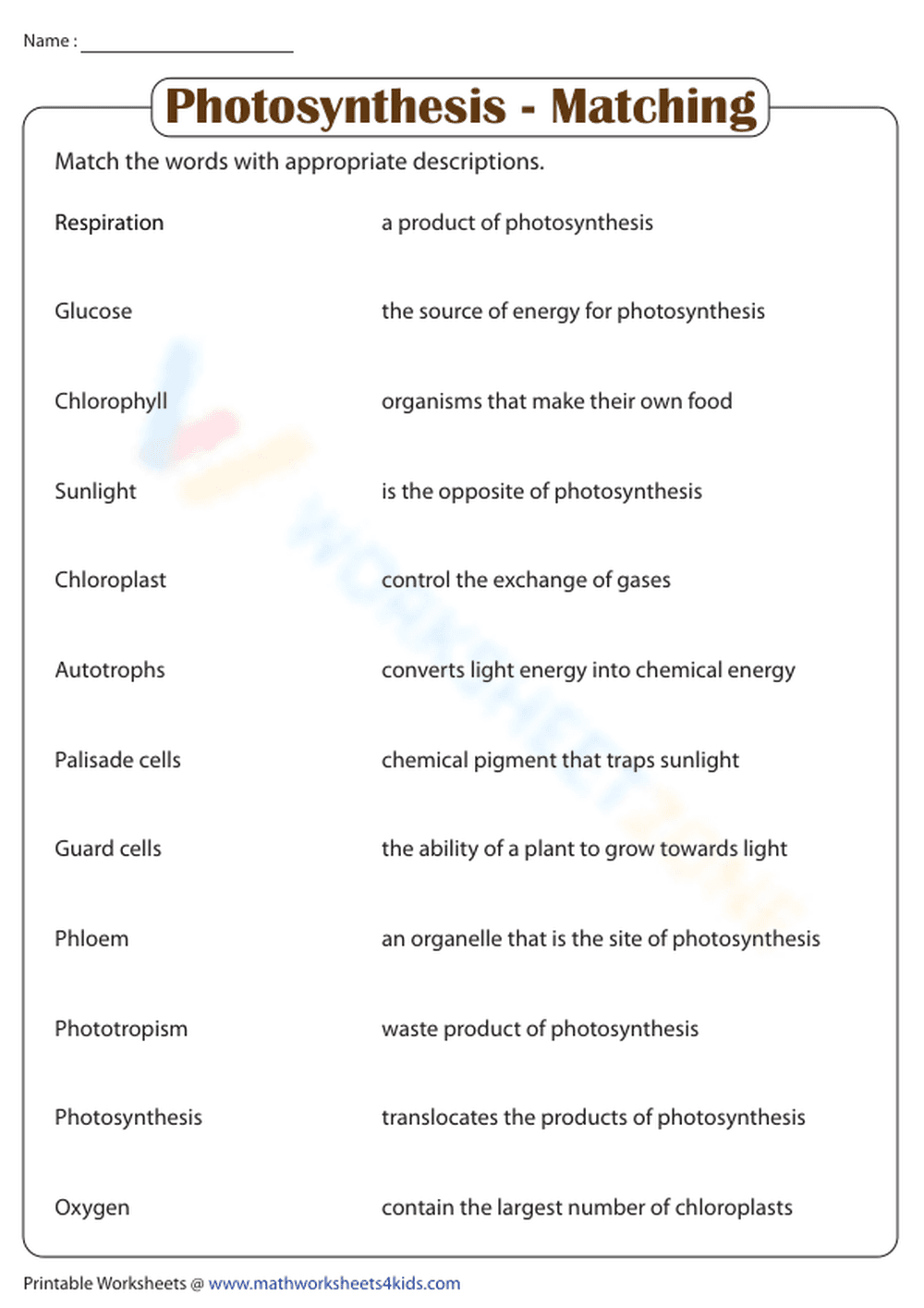
Master the complex biological processes of plant life with this Essential Photosynthesis Matching Activity. This worksheet provides a focused environment for middle school students to connect key scientific terminology with precise functional descriptions. By isolating 12 core concepts, students build the foundational vocabulary necessary for deeper inquiry into cellular respiration, energy transfer, and botanical anatomy.
At a Glance
- Grade: 6–7 · Subject: Living Things
- Standard:
MS-LS1-6— Explain the role of photosynthesis in the cycling of matter and energy- Skill Focus: Photosynthesis Vocabulary
- Format: 1 page · 12 problems · Answer key included · PDF
- Best For: Vocabulary reinforcement and formative assessment
- Time: 10–15 minutes
This single-page PDF features a clean, high-contrast layout designed for maximum readability and ease of use. It contains 12 matching tasks where students link terms like chlorophyll, autotrophs, and phototropism to their corresponding scientific definitions. The worksheet includes a dedicated name line and clear instructions, ensuring that no additional teacher guidance is required for student completion. A comprehensive answer key is provided to facilitate rapid grading or student self-checking.
Zero-Prep Workflow
This resource is optimized for the busy classroom environment with a simple three-step implementation plan. Print the master (30 seconds), distribute to the class (1 minute), and review answers using the key (3 minutes). Total teacher preparation time is under two minutes, making this an ideal "grab-and-go" resource for emergency sub plans or daily reinforcement.
Standards Alignment
Primary standard MS-LS1-6: "Construct a scientific explanation based on evidence for the role of photosynthesis in the cycling of matter and flow of energy into and out of organisms." This activity directly supports the "evidence" component by ensuring students possess the technical vocabulary to describe the matter and energy flow. Both standard codes can be copied directly into lesson plans, IEP goals, or district curriculum mapping tools.
How to Use It
Deploy this worksheet as a formative assessment mid-way through a unit on plant biology to identify students who may be confusing "chlorophyll" with "chloroplast." For best results, use it as a "Bell Ringer" at the start of class to activate prior knowledge before a laboratory investigation. While students work, circulate to observe which terms trigger the most hesitation, providing immediate feedback on specific conceptual gaps.
Who It's For
This resource is designed for Grade 6 and Grade 7 Life Science students, but remains accessible for Grade 5 advanced learners or high school biology students requiring remediation. It is particularly effective for English Language Learners (ELL) and students with IEPs who benefit from structured vocabulary practice. Pair this worksheet with a labeled diagram of a leaf or a short reading passage on the Calvin cycle for a comprehensive lesson.
Mastery of Tier 3 academic vocabulary is essential for bridging observation and scientific explanation. Fisher & Frey (2014) note that structured matching tasks support the gradual release of responsibility by providing low-stakes practice before complex writing. This photosynthesis worksheet aligns with MS-LS1-6 by reinforcing 12 terms required to describe plant energy conversion. Research from the NAEP Science Framework confirms that conceptual understanding in life science is tethered to accurate domain-specific language. By providing 12 problems on a single page, this classroom-ready resource enables teachers to gather data on student progress with zero prep time. The focus on photosynthesis ensures learners are prepared for middle school biology assessments.


